Thursday, July 2, 2015

A Walk Along the Lehama Canal: Ethiopia Day #5

200 year old DaEro tree - a sign that water is near.
Water is life. Especially in Ethiopia. People here say that if you see a DaEro Tree it means water. We see our first one twenty-five bumpy minutes after going off road in the Land rover. We are in the rural community of LemLem to see how D&P is helping Ethiopians adapt to climate change.

Sure enough, there is water nearby this particular beauty. The tree is over 200 years old. “This is the Lehama River,” Tekle Assefa tells us. It looks more like a trickle of water in a dry river bed right now though. The rains still have not come here.

Tekle works for the church and helps to oversee the project we are here to see – a 2km concrete canal that diverts water from the river to the fields of the people.

Children lead us along the canal.
A crowd gathers around us as we exit the cars and start our walk along the canal. The words canal may conjure up an image of ships passing between lakes, but only a tiny toy boat could travel this one. In the next few hours, we are amazed to see what a simple foot-wide channel of concrete can bring to a people suffering from dry lands.


The first beneficiary of the project that we meet is Adey Alemu. She is busy weeding her garlic field with her two young daughters. In total she has six children. The canal has allowed her to have more control over the amount of water going into her fields. Fields that are not irrigated are called “rain-fed.” With rain-fed fields these days, there is either too much water when the rains come, destroying the plants, or there is not enough. As part of the project, Adey has received training on crop production as well as the water from the canal.

Adey and one of her daughters, weeding their garlic bed.


 “Before the canal,” she says, “I could only have one harvest. Now with more control over the water I have two or for some crops even three. I am better able to provide for my family.”

The contrast with the rest of the countryside is readily obvious as we continue our walk. Things are green and growing here. We see tomatoes, lettuce, carrots, cabbage, maize, and more.

canal break to flow water to fields.
Every so often along the canal there are breaks that are stopped up by large rocks. These are what allow the water to flow into the farmer’s field. Their use is carefully managed by the community. In fact, improper use results in a fine of 50ETB.

We come across an herb garden as we continue and women offer us lovely smelling plants. One particular herb is used as a kind of fragrance for a woman’s hair. Others are medicinal.

At another point, one of the project workers stops to talk with a farmer working in his tomato field to give him advice on how to deal with a particular pest.

We see Woman and children coming to the canal to wash their clothes. I watch one child refresh herself by splashing water on her face. I stop and do the same. It is hot today!

Tesfay, 77 years old with hope for the future.
We come to another Daero tree. Here a trough has been diverted out of the canal to feed the cattle. They can also keep cool under the shade of the tree.

Towards the end we meet Tesfay. He is 77 years old. He has lived through the time of war and famine here and lost friends and loved ones. But that is not what he wants to remember. Instead he says, “I remember when I was young, there were many trees here,” he says. “People cut them all down. But today we are trying to bring them back.” By some estimates Ethiopia has lost 98% of its forested areas in the last 50 years. Tesfay is right though - this project is helping to bring the trees back, one small step at a time.

Speaking of small steps, the children of the community have been scampering along with us our whole trek. They wave goodbye to us as we finish our walk and return to our Land Rovers. Tesfay can feel good about their future.
The Future of LemLem.

Alula’s Coffee Shop: Ethiopia Day#4

Let me tell you about my new favourite spot for a coffee - Kallamino's.

Alula’s husband took all her money and left her alone with two small children to raise. She lives in the city of Me’Kele in the region of Tigray. She speaks to us through an interpreter in her native Tigrinya. “I was depressed with no hope. I went to the government for help and they sent me to the Daughters of Charity.” 

Daughters of Charity Women's Training Center
The Daughters of Charity are a religious order of nuns who have been in Tigray since the great famine in 1973. They work with the CST to improve livelihoods of women in the Tigray region. With our help, a livelihood training centre was built next to the coordinating office. At the coordinating office they run every type of social program you can imagine, from feeding children to a community library. Our work as D&P with them is focused on women like Alula.

Kallamino's.
The nuns gave her access to a loan of 8000ETB (400USD) which she would pay back at only 2% interest. They also made arrangements for her to set up a small cafeteria for the staff at a local boarding school. Together this support is known an IGA (Income Generating Activity)
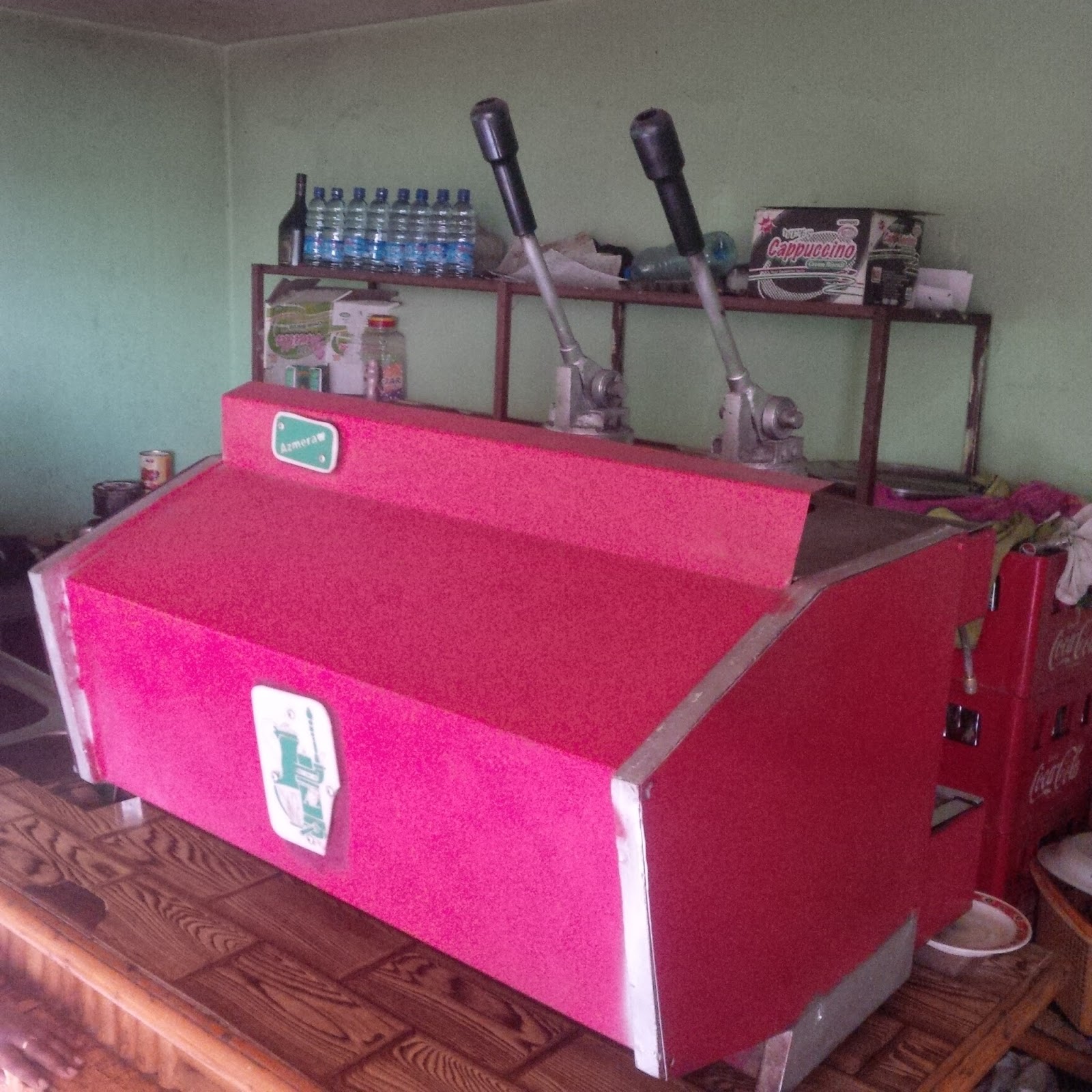
 She rents the space at the school for 200ETB (10USD) per month. We are visiting her there as she closes for the day. She used the original loan allowed her to get set-up and going, including renting a Coffee Machine that she rented for 400ETB a month. The coffee she prepares for us though is done according to the traditional Ethiopian coffee ceremony. Another young woman with a black headscarf is there serving us as she speaks. “I am the only cafeteria here. I have no competition so I have to ensure that I do not overcharge my customers and that my prices are fair."


Alula's Coffee Machine.
Alula works hard. She gets up early in the morning and prepares the injera in her home, that she then brings her shop. She works every day except public holidays. Her two daughters, now in Grades 9 and 6, help out at home. The hardwork paid off. She eventually was able to by the Coffee Machine outright for 23,000ETB, over 1100USD.

Her next purchase will be able to buy a fridge, “probably by September,” which she currently does not have. “Then I can serve cold drinks, which people want when it is hot and store food more easily.”

You see, she has not only paid back the loan. Alula’s business now affords her monthly profits of 3000ETB. “On a good day I gross 1500ETB in sales,” She tells us. And the young woman serving us the coffee? She is one of her two employees.

The name of Alula’s cafeteria is Kallamino, named for the small river that runs nearby. We try to pay her for the food and drink she has offered. After all, it is her business. She refuses. “Please, you are my guests,” she tells us. We do not insist and instead offer our gratitude.

Oh and by the way, Alula’s loan is just one of over 80 that the DOC sisters have given out since the start of the year. We are proud to support Alula and the Daughters of Charity in building a better world for Ethiopian women.


Alula, Closing up her coffee shop  Kallamino's.

Before and After Guidissa: Ethiopia Day #3

Guidissa Women's Self-Help Group
If you were an Oromo woman or girl living in the Kebele (neighbourhood) of Warqa Warabo before the days of Guidissa, your life might have looked like this: As a girl you experience female genital mutilation. As a widow you have no inheritance. You have no decision making power in your marriage and men in your village have the saying, “You can find a tall woman, but not a knowledgeable one.” You may take eggs or chicken to market to sell, but nothing larger. If you were to try and sell a goat or a cow, you would be looked on with suspicion and ignored. You are not allowed to plant by broadcasting seed or stand on the threshing ground, because men fear you will curse the crop. You have no involvement in community life and are confined to the home. You are poor and life is a struggle. But after the Guidissa, things are different.

Guidissa is the name of a woman’s self-help group in Warqa. It is an Oromo word meaning, “Helps to Develop.” It is one of four in this Kebele and consists of 38 women. Guidissa was organized through the work of a grassroots organization that our partner CST works with called Hundee. Hundee means “taproot” and they have acted as a taproot not only for Guidissa but for many other women self-help groups in over 31 Woredas (Districts) containing many Kebeles as part of the Civil Society Development Program supported by D&P. We did not have time to meet and visit them all they are so numerous. Some of our group split off to meet another of these self-help groups. We met the women of Guidissa. Despite having to be at a funeral later that day, all 38 of them are there to talk with us, along with their men. The meeting opens with a blessing. In the past it would have only been a man to do this. Now a woman also takes part.


men speaking in support!
Key activities of a self-help group like Guidissa include a revolving loan program for their members as well as community conversations with the men to discuss the their challenges. The men recognize the value of the conversations. “Previously we were not aware of the issue of gender,” one says,
“Now with the engagement in the conversations, the awareness of our equality is there. The next generations can have hope.”

With the revolving loan program, women start by contributing a very small amount of money each week to the group, as little as 1 or even 2 Birr (Ethiopian Currency 20 ETB=1USD). When the pot is large enough, members can take turns accessing loans as high as 2000ETB, in some cases at zero interest. This credit has the power to change lives.

Sharing powerful testimony.
One woman in a blue headdress shares with us, “My husband was a farm laborer and because of our poverty I had to live with my mother. I had nothing and struggled to survive. I was not a member of Guidissa. My mother told me to join the group. I refused because I did not think I could afford the fifty cents (half a birr) to save each week as a member. But eventually my mother got me to join. I was able to get a loan and buy four sheep. I sold two of them and was able to get a land contract to farm. My husband was able to return and help me. Together we produced 4.5 Quintal (1Quintal = 100kg) of Teff (a local grain). I still had the sheep and I was able to buy a heifer and a bull. I fattened them and sold them and then bought two oxen to farm and a donkey. I have paid back the loan and I can generate my own income. I am free. My children are free.”

Ejigua surveys her success.
After we talk we go to the homes of Ejigua Hailu. She is a founding member of Guidissa and one of its first beneficiaries. I say homes, plural, because there are two on her property – the stick and thatched-roof one she lived in before Guidissa and the solid, tin-roofed one she lives in now. Ejigua has nine children and five grandchildren. Getting access to credit allowed her to progress economically. She was gradually able to own more and more sheep (which she fattened and sold) before going on to also owning a cow (which had just given birth two days earlier to a calf).


Ejigua's new baby calf.
 This is life after Guidissa as a woman.
It is not only economic capital that is the fruit here – it is social capital as well. There is no more HTP (Hurtful Traditional Practices). You can sell goats and cows freely at the market. You can sow & thresh. You can join the Kebele councils and most importantly, you are an equal decision maker with your husband.

Support for women is directly in the mission statement of Development and Peace. Today we saw that mission in action.

Wednesday, July 1, 2015

Arrives Late and Leaves Early: Ethiopia Day#2

Me and Tamiru at the Restaurant.
The traditional Ethiopian music is thumping and I have to lean in closer to hear what Tamiru is saying. Tamiru is Oromo, the largest ethnic group in the country. I learn this because he mentions that the dancers on stage are dressed in his tradition. There are 40 million Oromo out of a total population in Ethiopia of 90+ million. We are at a restaurant enjoying a magnificent Ethiopian dinner with live musicians and dancers. In addition to the Oromo there are over 80 other different tribes that make up Ethiopia. Tamiru works in communications for the CST joint office, one of our key partners here. Leaning in further, I catch his words, “It Arrives Late and Leaves Early.” He is speaking about the rains. Ethiopia lies in a region of Africa that is prone to cycles of drought. These cycles are becoming more frequent and less predictable though. It’s a key reason why D&P is working here to enhance livelihoods and resiliance in vulnerable populations. Tamiru continues, “Just yesterday I was speaking to a priest from the north who told me they still have had no rain.” It has been raining all day in Addis and it should be elsewhere too. But it is not.

In addition to digesting the delicious food, we are also digesting vast amounts of knowledge that was shared with us today by two of our three key partners, CST and ECS. Two things jumped out for me that I would like to share.

First: The morning began with a briefing at the CST office, a five minute walk from our hotel. Ethiopia is known as the ‘Water Tower’ of Africa. There are rivers (including the Nile) that flow through the land. However, the diverse geography of the country means that water is easier to get in some places than others. It felt strange to be talking about drought and lack of access to water with the rain pouring down outside. Yet resilience to drought is key to development here, especially as its frequency increases. We are told that Climate Change is driving the ‘arrives late and leaves early’ phenomenon and presented with studies on the matter. The word of Pope Francis come to mind, that the poor, who have not created the ecological crisis, are the first to suffer from it.
Fasting Cake
During the break, the entire office staff came in with cake, coffee and drink to celebrate our visit and the return of our their leader who had been travelling for some time, Patricia Wall. There were two cakes, one was called a ‘fasting cake.’ A fasting cake contains no animal products as these are abstained from during fasting periods in Ethiopia. There is a lot of fasting in Ethiopia, by the dominant Orthodox Christians as well as the Catholics and the Muslims. “In total, there are over 200 days,” one of the staff tells me between bites of cake.


St. Mary Cathedral, Addis Ababa
The second thing jumped out at me during our visit to the Ethiopian Catholic Secretariat (ECS), the second key partner. It was a bumpy ride in the van through poor areas of the city to get there. Some of our group, who are seeing the type of urban poverty only found in the Global South for the first time, are overwhelmed. ECS is located right next to the St. Mary Cathedral, which we visit after our meeting. Newly minted Cardinal, Berhaneyesus Demerew Souraphiel, joined us for lunch and gave a very warm welcome to his Archdiocese. Catholics only make up between 0.5-1% of the population and consist of both Latin and Eastern rites. Yet despite being such a small percentage of the population, we are told that the Catholic Church is the second largest provider of health care and education in Ethiopia after the government! In the presentation of their work we are introduced to all kinds of acronyms. Two examples: HTP = Hurtful traditional practices (such as female genital mutilation and child marriages) & SWC = Soil Water Conservation. Here’s what I found noteworthy though: 25% of crop-loss for farmers comes post-harvest! For this reason, ECS puts as much emphasis on handling and processing harvested crops as it does on growing them.
 “The more you learn, the more you realize how much you don’t know,” commented one of our group. It is true. Today we have been focused on learning. Tomorrow we will begin our sojourn out into the field to see with our own eyes what today we have heard.

As I contemplate how much we have learned today, I now realize how little we will actually be able to see in our two weeks here. All of a sudden, Arrives Late and Leaves Early feels like words that not only describe the effect of climate change on the rains, but also like words that can also be applied to our trip. May God grant that we make the most of our precious time. 

Tuesday, June 30, 2015

Ethiopia #1: “I Don’t Know if You realize How Lucky You Are….”

Plane says we are about to land...
…these are the words my director, Josianne Gauthier, wrote to me as I was preparing to take-off for Ethiopia on Thursday. She continued, “The story of Ethiopia is deeply connected to the story of Christianity, of human dignity, colonialism, revolution, and the failure of the 1980’s model of development aid.  They have never been colonized and you can feel it…The landscape, the huge variety of cultures and ethnic groups that live across the country…and the coffee, the coffee is to die for. The first thing you notice when you get off the plane in Addis is the perfume of roasting coffee…”
She was right on both senses. I could feel it and the perfume did fill my nostrils. We have arrived here in Addis Ababa on June 28th as a group of 11 people from BC, ON and QC on a D&P Solidarity Trip. Solidarity trips are a chance for our members to see firsthand the work of D&P and its partners around the world. There are three main partners that we work with in Ethiopia and during this trip we will meet and learn from all of them. On this first day we will rest from the 12+ hour direct flight from Toronto and the 7hr jump ahead in time. Ironically, by coming here we have actually jumped 8 years back in time. Ethiopia uses the Julian Calendar and so it is actually the year 2007!
First Views of Addis Ababa
“I spent time sketching the view from my hotel window,” says Michelle, “Corrugated tin roofs and satellite dishes dominate.” Urban poverty as well as underdeveloped infrastructure is easily visible here. Growth is also visible in the form of scaffolding on rising buildings. It is made of Eucalyptus wood and looks like giant wooden skeletons with concrete innards – not exactly to Canadian Code. “The growth is a lie in many ways,” someone tells me, “The buildings represent the wealth of very few people. Income inequality is growing rapidly in Addis.”

For security reasons we do not visit the famous Markato, but instead visit a local market…in the rain. June is the rainy season and we are treated to our first Ethiopian downpour. Curious children approach us and as our English meets their Amharic, we do our best to communicate. I give a young boy my phone and he takes a picture of his little group. His smile is as wide as our own. We have arrived. I realize how lucky I am.

 Part of a series on the D&P 2015 Ethiopia Solidarity Trip. Internet Access is unreliable. I will post entries as I am able to.

Thursday, April 30, 2015

For Nepal, from the Dixon Mom.

Selfie with Gertrude
Gertrude Ambrose, aka the Dixon Mom, is celebrating her 75th birthday today with a donation to our efforts in Nepal. I met her at the CWL diocesan convention in Toronto. The CWL are great supporters of D&P and I have an info table there. "I never had problems speaking up for others," she says, "because I myself was pushed aside." She grew up a victim of the war in a small swiss border town. Despite having little education, she became a leader in her village.

At the age of 30 she came to Canada and married. "I have never been in love," she tells me. "I married the worst of the worst. After 36 years he died." She smiles. They call her the Dixon Mom because she is such an active member of her inner city Toronto neighbourhood on Dixon road. "I have no problem telling the men off when they do bad things. No one has sued me yet."

CWL convention
She lobbied to have bulletin boards out up in her building to advertise community events and volunteer opportunities. "Authorities want to spend millions on a p‎ool or a rec centre, instead of listening to the simple ideas of people who live here. A bulletin board gives people a sense of what is going on. Loneliness is the worst thing in the world you know."

Gertrude's eyes are lively brown. She zips around on her scooter from one place to the next. She leaves me with not only a donation, but a compliment. "You come down to my level, and you keep eye contact. You are a good listener."

I'm not a good listener though. I am just easily captivated by someone who flexes the muscle of the widow's mite.

Thursday, April 9, 2015

46 soups + 89 acts of generousity = Alleluia!

On Easter Sunday morning Ryan Worms and I completed our 46 day Lenten fast for Development and Peace - our contribution to D&P's annual ShareLent campaign to raise funds for it's mission.

I am grateful to the Catholic Register for publishing a reflection I wrote about the experience. Now that the fast is broken, I offer a few more words here on the Muse.

My wonderful wife Joanna (who was the first to sponsor me in the fast, of course) is Polish. In the Polish tradition Easter breakfast is one of special foods that are taken in a basket to be blessed at the Church on Easter Saturday. After greeting the Easter dawn down by the lake, we returned home and I broke the fast with wife and children as we shared an egg from that sacred meal together - a symbol of new life. As I did, my thoughts were with with many.

First, they were with Ryan, with whom I fasted. Believe it or not, we did not get to share a single soup together in person through the whole thing. On Holy Thursday though, we did a 'Skype Soup' as we remembered the last supper of our Lord. And of course, we talked shop over our french onions soups (he being, being french, had one infinitely better than my own feeble attempt!)

Second they were with all those we were fasting for. In particular this year, I thought of the people of Colombia (from the visit of Fr. Alberto) and the people of Syria - my heart being broken to tears most recently by 4 year old Hudea from the Atmeh  refugee camp.  

Finally, in a very special way, my thoughts were with the 89 people who supported the fast with donations - 89 acts of generousity.  At the Easter Vigil we break the silence of lent and sing Alleluia for the first time to greet the Risen Christ. You, the 89, were the Alleluia in my heart this Easter. Connecting with people was a special part of the fast for me - writing, begging, praying, thanking.  Yes, my heart would always leap whenever the email notifications would come in, "From: Development and Peace Subject: On-Line Contribution." I am so so grateful to all of you who helped me to not only reach my personal goal of $5000 but blow way past it to over $6000! I am happy to say that between the two of us, Ryan and I surpassed our combined goal of $10,000.  When one considers those who became monthly donors, that amount is amplified even more!

All in all my diet of 46 soups resulted in me losing between 30-35lbs (see the soup album here) . What was gained by the fast far outweighs the loss though. Going without brings things into focus. My heart has been even more finely tuned to the mission we proclaim as Development and Peace - that the Risen Christ offers hope for a broken world and that life is stronger than death. Alleluia!


breaking the fast!